Selecting an inductor for a power circuit involves more than checking an inductance value against a design target. Structural differences between component types can influence how a part behaves under load, how much space it occupies, and how well it tolerates the mechanical and thermal conditions of a given application. Molded inductors and wire-wound inductors represent two distinct construction approaches, each suited to particular design priorities rather than one being a universal replacement for the other.
This article outlines the main factors engineers typically weigh when comparing these two inductor types, without treating either construction as inherently superior.
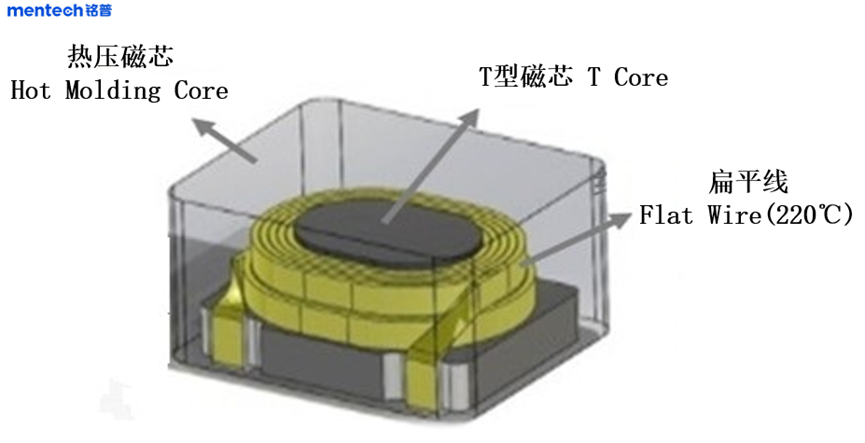
Structural Differences at the Core
A wire-wound inductor is generally built as a multi-component assembly, with a coil of wire wound separately and then combined with a core, often made of ferrite. This approach has been used for a long time because it is straightforward to manufacture and adapt to different winding configurations.
A molded inductor takes a different path, with the coil embedded inside a magnetic powder composite through a molding process, forming a single integrated component rather than an assembly of separate parts. This structural distinction is the starting point for most of the practical differences discussed below.
Magnetic Shielding Characteristics
Because a wire-wound inductor’s core and coil are separate elements, its magnetic path is generally open, which means it often relies on additional shielding elements, such as ferrite caps or rings, to contain magnetic flux. The effectiveness of this shielding depends on how these external elements are implemented.
A molded inductor, by contrast, forms a closed magnetic circuit as part of its basic construction, since the coil sits fully within the surrounding magnetic material. This tends to result in better flux containment without requiring separate shielding components, which is a relevant factor in densely packed boards where stray magnetic fields from neighboring components can become a concern.
Behavior Under High Current Loads
How an inductor behaves as it approaches its current limit is another point of comparison. Wire-wound inductors often exhibit what is sometimes described as “hard saturation,” where inductance can drop relatively abruptly once current exceeds a certain threshold. This behavior needs to be accounted for in circuit design, particularly in applications where current spikes are possible.
Molded inductors are generally associated with a more gradual saturation curve, sometimes referred to as “soft saturation,” where inductance decreases progressively rather than dropping sharply. This more predictable behavior can simplify circuit design margins in some applications, though the practical impact depends on the specific operating conditions and current profile involved.
Mechanical Stability and Vibration Resistance
The assembled nature of a wire-wound inductor means it can be more sensitive to vibration and physical stress over time, since the coil and core are distinct parts that can shift relative to each other under mechanical load. This is a relevant consideration in applications involving continuous vibration or repeated thermal cycling.
The single-piece structure of a molded inductor tends to offer more consistent mechanical durability, since there are fewer interfaces between separate components that could loosen or degrade. This characteristic is part of why molded inductors are frequently specified in automotive and industrial environments where mechanical stress is a routine part of the operating conditions.
Size, Current Handling, and Power Range
Molded inductors are often chosen where compact size needs to be paired with meaningful current capacity. Mentech‘s molded inductor catalog, for example, spans an inductance range from 0.047µH to 150µH, with current handling up to 120A and an operating temperature rating up to 155°C, figures that reflect a component category oriented toward board-level power conversion in a small footprint.
Wire-wound designs, however, remain relevant in a different part of the power range. Mentech’s high power wound inductor line, for instance, covers a power range from 2000VA to 500KVA, with insulation levels available at 1500V, 3000V, and 4500V. This places wire-wound inductors in a category suited to higher-power and higher-voltage-insulation requirements that fall outside the typical scope of compact molded components.
Matching Construction to Application Environment
Consumer electronics and portable devices, where board space is limited and vibration exposure is generally moderate, often favor the compact, shielded structure of molded inductors. Automotive systems, which combine space constraints with vibration and thermal cycling, present a similar case, and Mentech has developed an AEC-Q200-qualified molded inductor series specifically for this environment.
Industrial power equipment and larger power conversion systems, on the other hand, may call for the higher power handling and insulation ratings associated with wire-wound designs, particularly where voltage isolation requirements exceed what compact molded components are typically rated for. Neither construction type is universally preferable; the appropriate choice depends on the power level, insulation requirement, and mechanical environment of the specific system.
When Standard Parts Do Not Fit the Design
Standard catalog inductors, whether molded or wire-wound, do not always match a project’s exact space, current, or insulation requirements. In these cases, working with a manufacturer that offers both construction types along with custom development support allows a design team to specify parameters such as dimensions, turn configuration, or insulation rating more precisely rather than compromising on an off-the-shelf part.
Mentech manufactures both molded and wire-wound inductor product lines and offers custom development services for applications where standard specifications are not sufficient. This range allows engineering teams to compare construction types within a single supplier’s catalog rather than sourcing structurally different components from separate vendors.
Summary Considerations for Component Selection
Choosing between a molded inductor and a wire-wound inductor generally comes down to evaluating magnetic shielding needs, saturation behavior, mechanical environment, and the power or insulation range required by the application. For engineers looking to understand the technical basis for these differences in more depth, reviewing how a molded inductor achieves its closed magnetic structure can provide useful context before comparing it directly against wire-wound alternatives for a specific design.
As with most passive component decisions, reviewing the manufacturer’s datasheet for the specific part number under consideration remains the most reliable way to confirm whether its saturation characteristics, current rating, and insulation level align with a given circuit’s requirements.