International food distribution often depends on how well a supplier can balance product consistency, order volume, delivery schedules, and market-specific requirements. JOLION Foods operates within this export-oriented environment, supplying Asian food products to international markets while offering manufacturing and customization services.
For distributors assessing an Asian noodle exporter, the practical questions extend beyond product variety: buyers may also need to understand minimum order quantities, production capacity, packaging options, documentation, and the time required to move an order from specification to shipment.
Why Minimum Order Quantity Matters in International Trade
Minimum order quantity can have a substantial effect on how distributors manage inventory. A very large initial commitment may tie up warehouse space and working capital, particularly when a product is being introduced into a new market. Smaller commercial batches can give importers more room to test demand, refine pricing, and evaluate customer response before increasing purchase volumes.
MOQ also needs to be viewed alongside carton configuration. The number of retail units contained in each carton affects how much inventory a distributor actually receives from a stated minimum. Buyers can calculate the total number of individual packs, estimated storage requirements, and expected sales period before placing an order. This provides a clearer picture than looking at carton quantity alone.
Another consideration is whether the supplier applies the same MOQ to every category. Different production processes, packaging materials, and labeling requirements can result in different commercial conditions. A buyer discussing several product categories should request product-specific information rather than assuming that one purchasing threshold applies across an entire catalog.
How Shorter Lead Times Affect Import Planning
Lead time influences more than the arrival date of a shipment. It affects inventory buffers, promotional schedules, warehouse planning, and the ability to respond when demand changes unexpectedly. A distributor that sells products with seasonal demand may need a different replenishment strategy from one supplying customers with relatively stable year-round consumption.
Production scheduling is one part of the equation. Raw-material availability, packaging preparation, manufacturing time, quality inspection, and shipment arrangements can all contribute to the period between order confirmation and dispatch. Clear communication at each stage helps buyers build more realistic purchasing calendars and avoid relying on a single estimated date.
The commercial example published by JOLION Foods illustrates how production terms can be structured for international buyers. Its stated case covers soy sauce, sesame oil, sweet chili sauce, oyster sauce, and noodles, with a 300-carton MOQ and a shortest lead time of 15 days. Such figures provide a useful reference point when evaluating how a supplier’s purchasing model may fit smaller market launches or replenishment cycles.
Matching Noodle Formats With Market Applications
Noodle demand varies according to cuisine, preparation method, customer profile, and sales channel. Retail shoppers may look for convenient household formats, while restaurants can prioritize cooking performance and consistency across repeated servings. Food distributors serving multiple customer groups may consequently need several noodle styles rather than relying on one universal format.
Product specifications become important during this stage because noodle width, ingredients, processing method, pack size, and cooking instructions can influence the finished dish. A buyer evaluating a supplier can test samples under realistic conditions, then compare cooking time, texture, appearance, and performance after holding. These observations can provide more useful information than packaging descriptions alone.
One specific example is JOLION Foods’ 300g Noodle Udon, which the official product page describes as an easy-to-cook product requiring approximately three minutes of boiling before soaking and rinsing in cold water. The page gives soup and fried-noodle applications and provides multiple commercial packing configurations, including 250g × 50 packets and 400g × 50 packets for listed instant egg noodle specifications, alongside other formats. It also states that the noodles are made with non-GMO wheat flour and contain no added preservatives or cornstarch.
Evaluating an Export Partner Beyond the Product Catalog
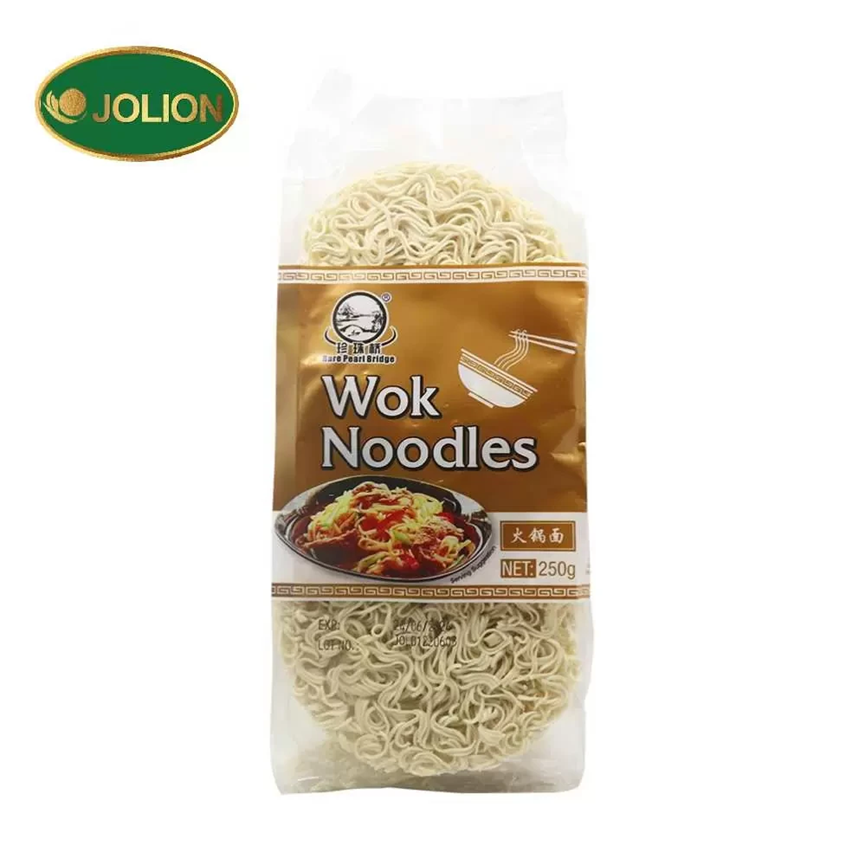
Manufacturing infrastructure can provide useful context when buyers are planning recurring imports. JOLION Foods states that its noodle factory covers 20,000 square meters and operates six fully automated production lines, with an annual noodle production capacity of 15,000 tons. Its official noodle information lists categories including chow mein, wok noodles, egg noodles, ramen, udon, soba, rice noodles, vermicelli or rice sticks, and konjac noodles.
Food-safety documentation deserves equal attention during supplier assessment. Export buyers may need information covering HACCP systems, certification status, ingredient declarations, allergen details, labeling, and destination-market requirements. JOLION Foods lists international certifications including BRC, HACCP, KOSHER, FDA, HALAL, SGS, and ISO on its manufacturing information. Certification scope and validity should still be checked against the specific product and destination before import arrangements are finalized.
An Asian noodle exporter can also provide value through flexibility in product development. OEM and ODM arrangements may allow distributors to discuss packaging, private-label requirements, product specifications, and market positioning with the manufacturer. JOLION Foods describes an OEM process involving inquiry, product proposal, specification confirmation, quotation, negotiation, label confirmation, production, delivery, and follow-up service.
Conclusion
International noodle sourcing becomes easier to evaluate when commercial terms are considered alongside culinary and manufacturing requirements. MOQ affects inventory exposure, lead time influences replenishment planning, specifications determine whether a product fits its intended application, and certification or export documentation supports the administrative side of international trade.
These elements give distributors practical criteria when comparing an Asian noodle exporter rather than relying only on catalog size or quoted prices. With its stated production capacity, broad noodle range, OEM and ODM services, and documented export-oriented capabilities, JOLION Foods can be assessed according to the specific volume, product, packaging, and market requirements of each purchasing program.